



Movement Intelligence
Teaches us to think and act like a movement in real cultural weather systems.
“After this the Lord appointed seventy-two others and sent them two by two ahead of him to every town and place where he was about to go.” — Luke 10:1
Movement is not a program; it's a dynamic system.
Movement Intelligence (MQ) is the ability to read the patterns of growth and health in organic, decentralized networks.
“Movements don’t spread because we try harder; they spread because the seed is viable and the environment is right. Our task is not to produce the movement but to remove what blocks it and align ourselves with the God who is already at work in the world.”— Alan Hirsch
Overview
Something has gone wrong with how we think about church growth. We have spent decades studying our best-attended gatherings, hiring consultants to reverse-engineer the most impressive institutions, and scaling what appears to work — and the net result is that the church in the West has become very good at attracting people who already like church, and very poor at reaching those who do not. We have confused institutional success with movement dynamics. They are not the same thing, and optimizing for one often makes the other harder.
Movement Intelligence (MQ) is the capacity to read culture and act with catalytic wisdom — to think and act like a movement in real cultural weather systems. The distinction between institutional intelligence and movement intelligence is not about size or style. It is about the fundamental logic of how growth happens. Institutions grow by aggregating — by building better programs, expanding facilities, attracting better communicators, and drawing people toward a center. Movements grow by distributing — by multiplying agents, releasing ordinary people for mission in their natural networks, and spreading the gospel through the relational fabric of everyday life.
The Kingdom of God operates on movement logic. Jesus sent seventy-two ordinary people — not trained rabbis, not credentialed clergy, not professional missionaries — to every town and place he was about to go. They went in pairs, without institutional backing, dependent on local hospitality, looking for persons of peace who would open their homes and their networks. This is not a primitive form of church planting that has been superseded by professional models. It is the pattern Jesus used because it works — because movements spread through ordinary people in ordinary networks more effectively than any top-down institutional strategy.
The reframe at the heart of this pathway is significant: the question is not “how do we get more people into our thing?” but “how does the reign of Christ spread through networks, neighborhoods, and systems?” These questions orient you toward entirely different strategies. The first question produces attractional programs designed to attract interested people. The second question produces incarnational communities designed to send ordinary disciples into the social fabric of their context, looking for where God is already at work.
Movements learn faster than institutions. This is not an accident. Institutions are designed for stability and consistency — they preserve what has worked and resist change. Movements, by contrast, are designed for adaptation — they run micro-experiments, debrief rapidly, adjust, and try again. The Learning Loop that is the framework of this pathway (Define → Do → Debrief → Share) is not a project management tool. It is the basic unit of movement intelligence: the rhythm by which a community of ordinary disciples becomes collectively wiser about its mission field, more attentive to where God is at work, and more capable of faithful, contextually appropriate response.
Reading “the weather” is perhaps the most vivid image for what movement intelligence requires. Every context has its own cultural weather systems — its patterns, its winds, its seasons, its sudden storms. Paul in Athens read the weather: he noticed their altars, quoted their poets, named their unknown god, and connected their deepest longings to the resurrection of Jesus. He did not preach the same sermon he preached in Jerusalem. Movement intelligence is contextual intelligence — the discipline of paying close enough attention to your specific neighborhood, your specific networks, and your specific cultural moment that you can act with the wisdom that context requires.
The usual question:
How do we get more people into our thing?
The better question:
How does the reign of Christ spread through networks, neighborhoods, and systems?
The Learning Loop
Movements learn faster than institutions — not because their people are smarter, but because of how they structure their learning. Institutions typically follow an annual planning cycle: identify a strategy, implement it over months or a year, evaluate at the end, and adjust for the next year. Movements, by contrast, run micro-experiments in 2–4 week cycles, debrief immediately, adjust quickly, and share their learning across the network so others can benefit. The result is that movements accumulate contextual wisdom at a rate that institutions cannot match. The Learning Loop is the basic unit of movement intelligence practice: Define a specific experiment, Do it, Debrief what happened, and Share the learning. This cycle, repeated consistently by ordinary disciples, transforms a community from a consumer of mission strategy into a producer of contextual wisdom. That transformation — from dependent to generative — is the hallmark of movement intelligence.
Define
The Define phase is about specificity. Movements fail at this stage when they set intentions rather than defining concrete, time-bound, observable experiments. A well-defined experiment has three qualities: it involves one specific action, it has a clear time frame (2–4 weeks is ideal), and it is small enough to actually do without institutional support. Examples: one intentional conversation per week with a neighbor; hosting one meal for coworkers; visiting a specific local gathering place every week with your eyes open. The discipline of specificity is the discipline of commitment — vague intentions produce vague action, and vague action produces no learning. Define your experiment precisely enough that at the end of the time frame you can say unambiguously: did I do it or not?
Do
The Do phase is about faithful execution and attentive observation simultaneously. The goal is not to perfect the experiment before starting — it is to try, to be present, and to pay close attention to what happens. Luke 10 is the model: Jesus sends the seventy-two with clear instructions and with the expectation that the experiment will generate information. “Where is God?” is the primary observational question — not “is this working?” in a utilitarian sense, but “where is the Spirit already moving, and how do I join what is already happening?” The Do phase requires the discipline of presence: actually showing up, actually having the conversation, actually hosting the meal. Preparation without execution is not movement intelligence.
Debrief
The Debrief phase is where learning is consolidated and articulated. Without a disciplined debrief, the same experience produces very little wisdom — the doing happens but the learning evaporates. A good debrief is structured around four questions: What did I do? What happened as a result? Where was God in it? What would I do differently or what do I want to try next? The discipline of writing matters: the act of writing forces the consolidation of observation into insight. Share your debrief with at least one other person before it becomes purely private reflection. The accountability of sharing creates the discipline of noticing, and the discipline of noticing is the foundation of contextual intelligence.
Share
The Share phase is what transforms individual learning into movement intelligence. When one disciple’s experiment remains private, it produces one disciple’s wisdom. When it is shared across a community, it produces collective learning that multiplies. The sharing creates accountability, spreads learning so others can try variations, and builds a culture of mission-as-practice rather than mission-as-event. Sharing does not require a formal meeting — it can happen in a small group, over coffee, in a brief story told in a gathering. The gospel spread in the first century through shared practice — disciples telling other disciples what they were seeing, where the Spirit was moving. The Share phase recovers this as deliberate practice.
The Learning Loop is deliberately non-scalable in one sense — it requires real experiments with real people in real places, and there is no shortcut. But it is scalable in the only way that matters: every disciple can run it, in any context, without institutional support. This is how movement intelligence multiplies across a community: not through programs delivered from the center but through dozens and hundreds of ordinary disciples each running their own loops, sharing their learning, and collectively becoming wiser about where God is at work.
Visualizations
Two pictures of what movement intelligence actually looks like — the architecture of distributed growth, and the rhythm that produces it.
Centralized. Expert-dependent. Remove the head and the organization dies.
Distributed. Ordinary disciples as agents. Remove any part and the organism reproduces.
Twin Movements: Missional and Incarnational
The missional-incarnational impulse has two dimensions that work together. Missional is the outward movement — going out, sentness. Incarnational is the inward movement — going deep, taking flesh in context. Together they produce the movement posture of a church that embodies the direction of the Incarnation: God moving toward humanity.
Missional: The Outward Thrust
God is a missionary God. The Father sends the Son. The Son sends the Spirit. The Spirit sends the church. We go. We do not wait for people to come to us. Luke 10: Go. Find persons of peace. Stay. Proclaim. The posture is always outward-and-prior — moving toward the people we are sent to before they move toward us. This is not a strategic preference; it is the shape of the Incarnation applied to the church’s life in the world.
Incarnational: The Inward Movement
Incarnation means taking flesh. Jesus became fully human — not merely visiting, but dwelling. We practice incarnational presence through six disciplines: presence (actually be in the place), proximity (be close to the people), powerlessness (serve from below, not above), prevenience (God is already here before us), passion (love the people genuinely), proclamation (speak the word that names what God is doing). We become native to our context. Not tourists, but residents.
Movement Intelligence in History
The Moravian Movement: The Moravian story begins not with strategic planning but with displacement and suffering. Descendants of the Bohemian Reformation, survivors of a century of persecution, they settled on the estate of Count Nikolaus von Zinzendorf in Saxony in 1722, founding the community of Herrnhut. On August 13, 1727, during a communion service, the community experienced what participants described as an overwhelming awareness of the Holy Spirit. From that event emerged a commitment to continuous prayer: members took turns in hourly prayer shifts around the clock. This prayer meeting continued without interruption for over 100 years. From this foundation of communitas and prayer, the Moravians sent missionaries to the Caribbean, to Greenland, to South Africa, to North America — reaching populations no other church was reaching. Within twenty-five years of Herrnhut’s founding, they had launched more missionaries than the whole of Protestant Christianity had sent in the preceding two centuries. Their ratio of missionaries to total community size has never been matched by any Protestant group. Communitas — deep community forged in liminality and shared mission — was the foundation. And the learning loops embedded in their shared life (letters between communities, public reading of missionary reports, the prayer meeting itself as a continuous debrief before God) were the movement intelligence infrastructure that sustained extraordinary geographic and demographic reach.
The Methodist Movement: The Methodist movement under John Wesley is one of the most documented and instructive case studies in movement dynamics — because it includes both the activation of movement intelligence and its subsequent suppression. At the height of Methodist expansion, growth was produced by a specific structural configuration: classes (small groups of around 12 meeting weekly for mutual accountability), bands (smaller groups of 4–6 for deeper confession and prayer), and circuit riders (lay preachers, not ordained clergy, who traveled circuits of multiple communities). Ordinary people leading ordinary people at a scale no professional clergy system could have matched. Classes could be started anywhere, by anyone who had been through the system, with no institutional overhead. The result: from 2% to 34% of American churchgoers in 75 years. The stall arrived at precisely the moment the movement introduced professional gatekeeping — requiring ordination and seminary training for those who would lead its communities. The circuit riders who had been ordinary laypeople became professional ministers. The simplicity that had allowed the movement to reproduce through any motivated disciple was replaced by complexity that required institutional support. The movement’s growth trajectory flattened and eventually turned negative. Methodism has never regained positive growth since the professionalizing moment. The lesson is stark: movement intelligence is not simply a set of attitudes; it is a set of structural commitments about who can lead, how communities form, and what can be released without institutional authorization.
“Movements don’t spread because we try harder; they spread because the seed is viable and the environment is right. Our task is not to produce the movement but to remove what blocks it and align ourselves with the God who is already at work in the world.”
— Alan Hirsch
Watch for the Distortion
- Movements spread through ordinary people, not just leaders
- Learning loops: define, do, debrief, share — rapid contextual adaptation
- Persons of peace: insiders who open their networks to the gospel
- Networks over silos; permission over control
- Contextual intelligence: reading the cultural weather of your specific place
- Technique without theology — adopting movement language as a growth strategy without theological foundation
- Measuring what is easy (attendance, giving) rather than what matters (multiplication, reach, formation)
- Centralization that kills agency — requiring permission structures that prevent ordinary disciples from acting
The Biblical Mandate
Luke 10:1–12
The New Testament’s most concentrated description of Movement Intelligence in practice. Five principles are embedded in Jesus’s instructions. Go — the direction is outward and prior; Jesus sends them where he is about to go, which means their missional engagement prepares the ground for his presence. Two by two — the basic unit of mission is not the individual hero but the pair: accountable, mutual, capable of debrief and reflection. No institutional infrastructure — no purse, bag, or sandals; no organizational support structure. The experiment must be runnable without backing, forcing dependence on persons of peace rather than institutional resources. Find persons of peace — the gospel spreads through relational networks; the person of peace is the insider who opens their household and their network. Stay — depth over breadth; remain in one household rather than moving from house to house: take flesh in a specific place with specific people, become native, earn the right to be heard.
Acts 8:1–4
A great persecution broke out against the church in Jerusalem, and all except the apostles were scattered throughout Judea and Samaria. Those who had been scattered preached the word wherever they went. The scattering is a movement dynamic, not a disaster. When the institutional center in Jerusalem was disrupted, the movement did not die — it multiplied. The ordinary disciples who scattered became the missionaries. The gospel spread precisely because it could not be contained in a single center. This is the starfish principle in biblical narrative: remove the center and the movement reproduces from every part. For Movement Intelligence, this passage is essential: the ordinary disciple scattered into everyday life is the primary agent of movement expansion.
Matthew 13:31–33
The Kingdom of heaven is like a mustard seed — the smallest of all seeds that becomes the largest of garden plants. It is like yeast mixed into sixty pounds of flour until it worked all through the dough. Jesus uses two organic, viral images to describe how the Kingdom spreads — not like a construction project that progresses according to plan, but like a seed planted in soil and like yeast mixed through dough: invisible, distributed, working through the whole from the inside. Movement Intelligence reads these parables as structural descriptions: the Kingdom spreads through ordinary, distributed, organic processes, not through top-down institutional management.
1 Thessalonians 1:5–8
Our gospel came to you not simply with words but also with power, with the Holy Spirit and deep conviction. You became imitators of us and of the Lord. And so you became a model to all the believers in Macedonia and Achaia — the Lord’s message rang out from you not only in Macedonia and Achaia; your faith in God has become known everywhere. The Thessalonian church is a case study in viral movement dynamics: the gospel came to them with power, they received it, they became imitators, they became a model, and the word sounded forth from them to regions beyond. They did not have a communications strategy; they had a transformation that made them a living message. Movement Intelligence looks like this: a community so genuinely changed by the gospel that the change itself becomes contagious.
Supporting Texts
The Chinese underground church grew from 2 million to an estimated 120 million through networks of ordinary disciples with no buildings, no trained clergy, and no institutional support — and the movement accelerated when persecution was most intense. Movement Intelligence is always the same: distributed, relational, ordinary people, learning loops, contextual wisdom, permission structures that release rather than control.
Historical Witnesses
Case Study: The Early Church in Acts
Case StudyThe early church’s growth is the definitive case study in Movement Intelligence. In approximately two centuries, it grew from a group of around 120 disciples to an estimated 20 million — approximately 10% of the Roman Empire’s population. No existing organizational theory fully accounts for this growth because it did not follow institutional logic. It followed movement logic.
The primary unit of early church life was not the synagogue-style gathering but the household — the oikos. Households in the ancient world were networks: family, servants, workers, guests, neighbors. When the gospel entered a household, it entered a relational network that extended naturally to adjacent households. This is the persons-of-peace principle operating in its natural environment. Lydia’s household in Philippi, Cornelius’s household in Caesarea, the household of Stephanas in Corinth — each conversion is simultaneously a network event, not just an individual transaction.
Acts 8:1–4 records what appears to be a catastrophe — great persecution drives the Jerusalem church into exile. Luke’s editorial comment is extraordinary: “Those who had been scattered preached the word wherever they went.” The persecution did not destroy the movement; it distributed it. The ordinary disciples who fled became missionaries in their new locations. The gospel spread precisely because it could not be contained in a single institutional center. This is the starfish principle in biblical narrative: remove the head and the movement reproduces from every part.
The early church ran what we would now call learning loops constantly. Peter’s vision of the unclean animals is a theological debrief — God reframes his existing framework through vision and subsequent experience with Cornelius. The Jerusalem Council is a community-wide debrief of what God has been doing in the Gentile mission, followed by a course correction and a shared communication of the new framework. Paul’s missionary journeys are iterative: he goes, he observes what opens and what closes, he adjusts his approach (Athens is different from Corinth, which is different from Jerusalem), and he reports back. Movement Intelligence was not a theory the early church adopted; it was the posture the Spirit led them into.
Historical Archetypes
Learning Loops in Acts
Early Church — Jerusalem Council and Gentile mission show Define → Do → Debrief → Share as Spirit-led adaptation.
View Archival Study
Starfish Networks
Contemporary movements — Decentralized disciple bands adapted faster than centralized institutions when cultural weather shifted.
View Archival StudyHow to Develop Movement Intelligence
Your First Micro-Experiment
Choose one concrete missional action to define as your experiment. The experiment must meet three criteria: it involves a specific action (not an intention), a specific time frame (2–4 weeks), and a specific context (a named neighborhood, a named workplace, a named third space). Write the experiment down in one sentence: “I will [specific action] with/in [specific place or people] [specific frequency] for [specific time frame].” Examples: “I will spend one hour on Tuesday evenings at the café on our street, with my eyes open for conversation, for the next four weeks.” “I will pray for three specific neighbors by name every morning for the next month.” The discipline of writing the experiment forces specificity, and specificity creates accountability. Share your experiment with one other person before you begin — not for permission but for accountability.
Do and Debrief
Execute your experiment and maintain a simple observation journal. After each missional engagement, write for at least 10–15 minutes using four questions as your structure: What did I do? What happened? Where was God in it? What do I want to try next? Do not analyze prematurely — write what you observed before you interpret it. At the end of your experiment’s time frame, write a 200-word debrief that synthesizes your observations: What did you learn about the context? What did you learn about yourself? Where did the Spirit seem to be moving? What surprised you? Share this debrief with at least one other person — not for evaluation but for reflection. The act of articulating your learning to another person consolidates it in ways that private journaling alone does not achieve.
Identify Your Person of Peace
Over the course of 6–8 weeks of regular presence in a specific context, look for persons of peace — people who seem open, who respond with curiosity rather than suspicion, who have relational credibility in the network around them. This is not a technique; it is an attentiveness. You cannot manufacture a person of peace; you can only create the conditions to encounter one. Conditions: regular presence (show up to the same place consistently), genuine interest (ask questions and listen more than you speak), low-pressure presence (do not arrive with an agenda; arrive as a neighbor). When you sense someone may be a person of peace, test the hypothesis gently: offer help, invite to a meal, introduce to others in your community. People of peace typically reveal themselves by the quality of their response — they open up, invite you further in, introduce you to others.
Build a Learning Community
The Learning Loop becomes most powerful when practiced by a group rather than an individual. Gather 4–6 people who are each running their own missional experiments in their respective contexts. Meet every two weeks to share debriefs using the four questions. As you listen to each other’s stories, look for patterns: Where are multiple people seeing similar openings? Where are multiple people encountering similar obstacles? What is the Spirit doing in your neighborhood collectively? This shared debrief begins to build genuine community intelligence about your context — not one person’s observations but the cumulative learning of multiple disciples over time. Over 3–6 months, this group will develop contextual wisdom that no individual experiment could produce alone.
Read the Weather Intentionally
Once a month, take two hours to study your missional context with the eyes of an anthropologist. Walk your neighborhood, sit in a public space, visit a local gathering place, attend a community event — not to evangelize but to observe. Ask: What is this community anxious about? What is it hoping for? What does it celebrate? What does it grieve? Where are the natural third spaces where community forms? Who are the connectors? Where are the edges — the people and places the community’s mainstream tends to overlook? Write your observations in a context journal that you add to monthly. Review it every three months to look for patterns. This practice, over 6–12 months, will produce a thick description of your missional context that becomes the foundation for increasingly intelligent missional engagement.
Your First Step
First Step: Define your first micro-experiment. One specific action. One specific context. One specific time frame. Write it in one sentence. Share it with one other person. Then go. Movement intelligence begins with a single act of presence — not a strategy, not a program, not a plan. One disciple, one context, one experiment, one debrief shared with one other person. This is how every major Jesus movement in history began.
The MQ Arc
See
Reframation — we learn to see the world as God sees it before we act in it
Turn
Metanoia — we turn toward the Jesus-given design before we operate it
Align
mDNA — we align to the genetic code that produces movement before we practice it
Operate
Movement Intelligence — we run the design in real cultural weather with learning loops and contextual wisdom
Multiply
Discipleship — the life-on-life formation that propagates what movement intelligence releases
Reframation → MQ: Reframation opens the eyes to see the culture you are sent into. Contextual intelligence requires the capacity to see truthfully. → Metanoia: MQ without the U-turn of metanoia produces activity without transformation. The cultural weather can only be read from the inside of a turning community. → mDNA: mDNA gives the design; MQ teaches you to operate it. The missional-incarnational impulse is the mDNA element that MQ develops most directly. → Discipleship: The learning loops of movement intelligence mirror the rhythms of life-on-life discipleship — both are built on experiment, debrief, and transmission across generations.
Deepen Your Journey
Formation courses for this pathway are coming soon. In the meantime, explore Alan's published courses.
Browse CoursesCurated Resources
Selected Bibliography & Media

Common Confusions
Reflection Questions
Your missional context
What is your missional context — the specific neighborhood, workplace, or network where you are most embedded? How well do you know it? Could you describe its cultural weather — what it is anxious about, hoping for, celebrating, grieving?
Persons of peace already present
Who are the persons of peace already in your network — people who are open, who connect others, who might be a bridge to a wider community? Have you been paying attention to them? Have you made a move toward them?
Waiting for permission
Where have you been waiting for institutional permission or support to begin a missional experiment that you could actually start this week without either? What has the waiting cost?
What your community celebrates
What does your community most celebrate? If a stranger attended your gatherings for a month, would they conclude that you are organized primarily for mission or primarily for the care of existing members? What would the budget, the calendar, and the stories told from the front say?
The Methodist lesson
The Methodist movement stalled when it required professionals to lead what ordinary disciples had been doing. Where in your community is expertise a barrier to reproduction — where do things require trained leaders that ordinary disciples could carry?
The debrief you didn’t take
Think about a missional engagement you have had recently — a conversation, a moment of service, a shared meal. Did you debrief it? Did you share what you learned? What wisdom was lost because you didn’t?
The Moravian prayer meeting
The Moravians sustained a 100-year prayer meeting as the energy source and learning loop of their movement. What is the prayer infrastructure of your missional community? What sustains the spiritual attentiveness that movement intelligence requires?
The debrief of the seventy-two
The seventy-two returned with joy and debriefed with Jesus. What would it look like for your community to build regular collective debriefs into its rhythm — not program evaluations but genuine reflection on where the Spirit has been moving?
Scattered well
The gospel spread in the first century through ordinary disciples scattered into everyday life. What would it mean for your community to be “scattered well” — equipped, sent, and supported as missionaries in their daily contexts rather than gathered for programs?
Joining what is already happening
Where is God already at work in your neighborhood or network — before you arrived, without your assistance? What would it mean to join that rather than start something new?
Movemental Vocabulary
The language of Movement Intelligence. These terms are not jargon — they are precision tools for seeing what institutional Christianity has suppressed and what every major Jesus movement in history has operated by.
Movement Intelligence (MQ)
The capacity to read culture and act with catalytic wisdom — to think and act like a movement in real cultural weather systems. Portal 4 in Alan Hirsch’s five-portal framework. Encompasses contextual intelligence, the Learning Loop, the starfish principle of decentralized networks, and the mobilization of ordinary disciples as the primary agents of mission.
The Learning Loop
The basic unit of Movement Intelligence practice: Define (a specific missional experiment) → Do (execute with attentive presence) → Debrief (articulate what happened and where God was) → Share (spread the learning across the community). Repeated consistently, the Learning Loop transforms communities from consumers of mission strategy into producers of contextual wisdom.
Person of Peace
From Luke 10:6. The insider whose heart is open, whose home is welcoming, and whose relational network opens as a result of their reception of the missionaries. The person of peace is the mechanism by which the gospel enters a new network. Finding persons of peace requires regular presence, genuine interest, and patient attentiveness rather than aggressive outreach.
Contextual Intelligence
The capacity to discern the cultural currents, opportunities, and obstacles in a specific context and act accordingly — the “reading the weather” discipline. Paul in Athens demonstrates contextual intelligence: he notices their altars, quotes their poets, and names their unknown god before connecting their longings to the resurrection of Jesus. Developed through proximity, observation, and theological attunement.
The Starfish Principle
Drawn from Ori Brafman and Rod Beckstrom’s The Starfish and the Spider, a book Alan Hirsch frequently references. A starfish has a distributed nervous system — cut it in half and you get two starfish. A spider has a centralized nervous system — cut off its head and it dies. The Starfish Principle describes the architecture of decentralized movements versus centralized institutions: movements reproduce from any part, accelerate under disruption, and require no central authority to multiply.
Missional-Incarnational Impulse
One of the six mDNA elements (Element 3), developed most fully in the MQ portal. Missional is the outward thrust — going to people, not waiting for people to come. Incarnational is the inward movement — taking flesh in specific places with specific people, becoming native to context. Together, they describe the movement posture of a church that embodies the direction of the Incarnation: God moving toward humanity.
Oikos
Greek: household. The primary social unit of early church mission. In the ancient world, the oikos included family, servants, workers, and regular guests — an extended relational network. The gospel spread through households because households were already-existing networks. The person-of-peace approach is an oikos strategy: find the connector whose oikos will open to the gospel when they receive the missionaries.
Prevenience
The theological conviction that God is already at work in every context before the missionary arrives — ahead of us, preparing hearts, opening networks, moving in ways we have not yet observed. Contextual intelligence begins with prevenience: we do not bring God where he is absent; we discern and join where he is already present. The question “Where is God already at work here?” is the foundational question of movement intelligence.
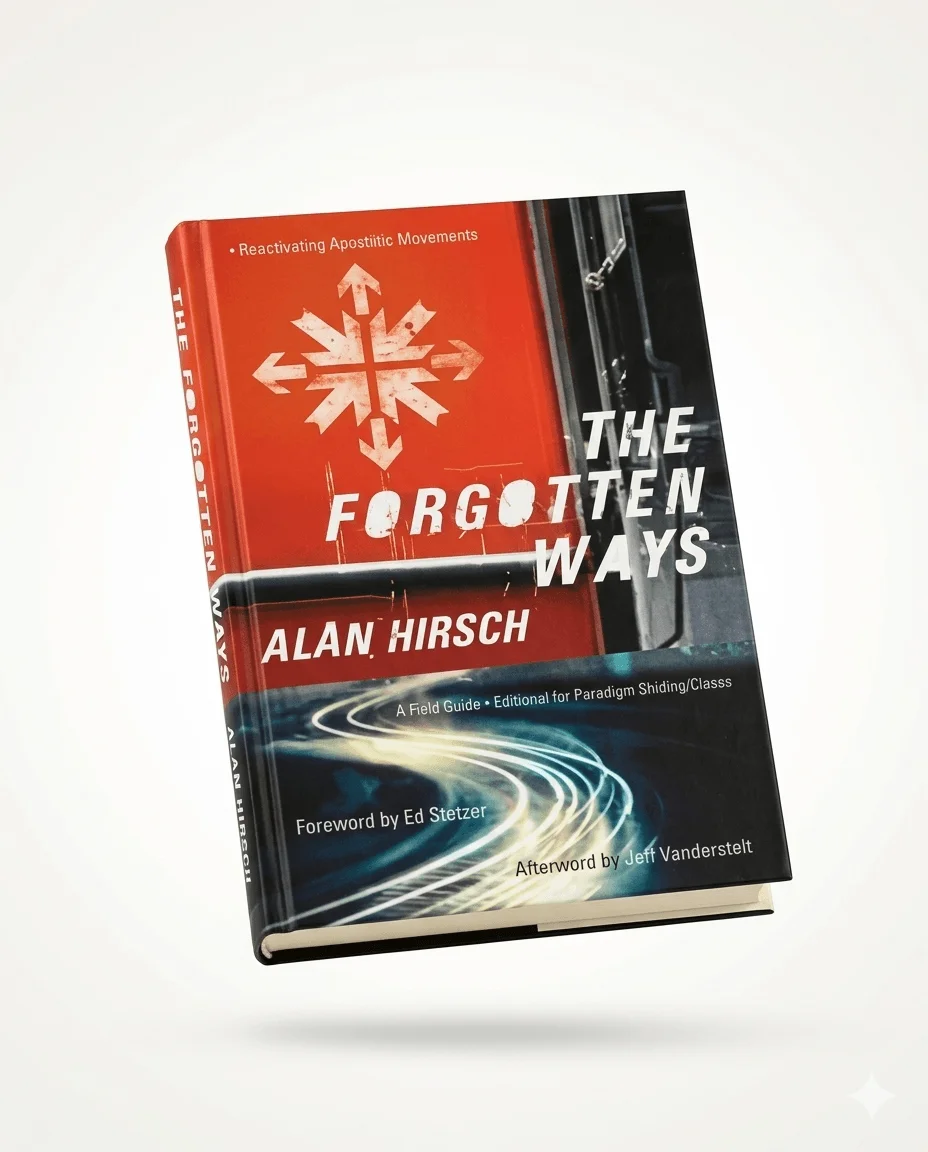
Explore Learning to Think and Act Like a Jesus Movement
This door leads into Learning to Think and Act Like a Jesus Movement. Movements don’t spread because we try harder; they spread because the seed is viable and the environment is right. Come and learn to read the weather.
Enroll NowAbout Alan Hirsch
Experience
- 40+ years in missional theology, church planting, and movement leadership
- Co-founder of 5Q Collective (activating APEST globally)
- Co-founder of Movement Leaders Collective
- Partner and strategist with 100 Movements
Expertise
- Author of 18+ books including The Forgotten Ways, 5Q, Reframation, The Permanent Revolution, Untamed, and Disciplism
- Developer of foundational frameworks: mDNA (Missional DNA), APEST (fivefold ministry), Apostolic Genius
- Contributor to the conversation on missional ecclesiology, apostolic movement, and discipleship multiplication
- Curriculum development for Forge, 5Q, and Movement Leaders Collective
Interrogate the Movement Intelligence Framework
Our neural engine has indexed over 4,000 pages of missional monographs. Ask a specific theological or practical question to start your inquiry.