


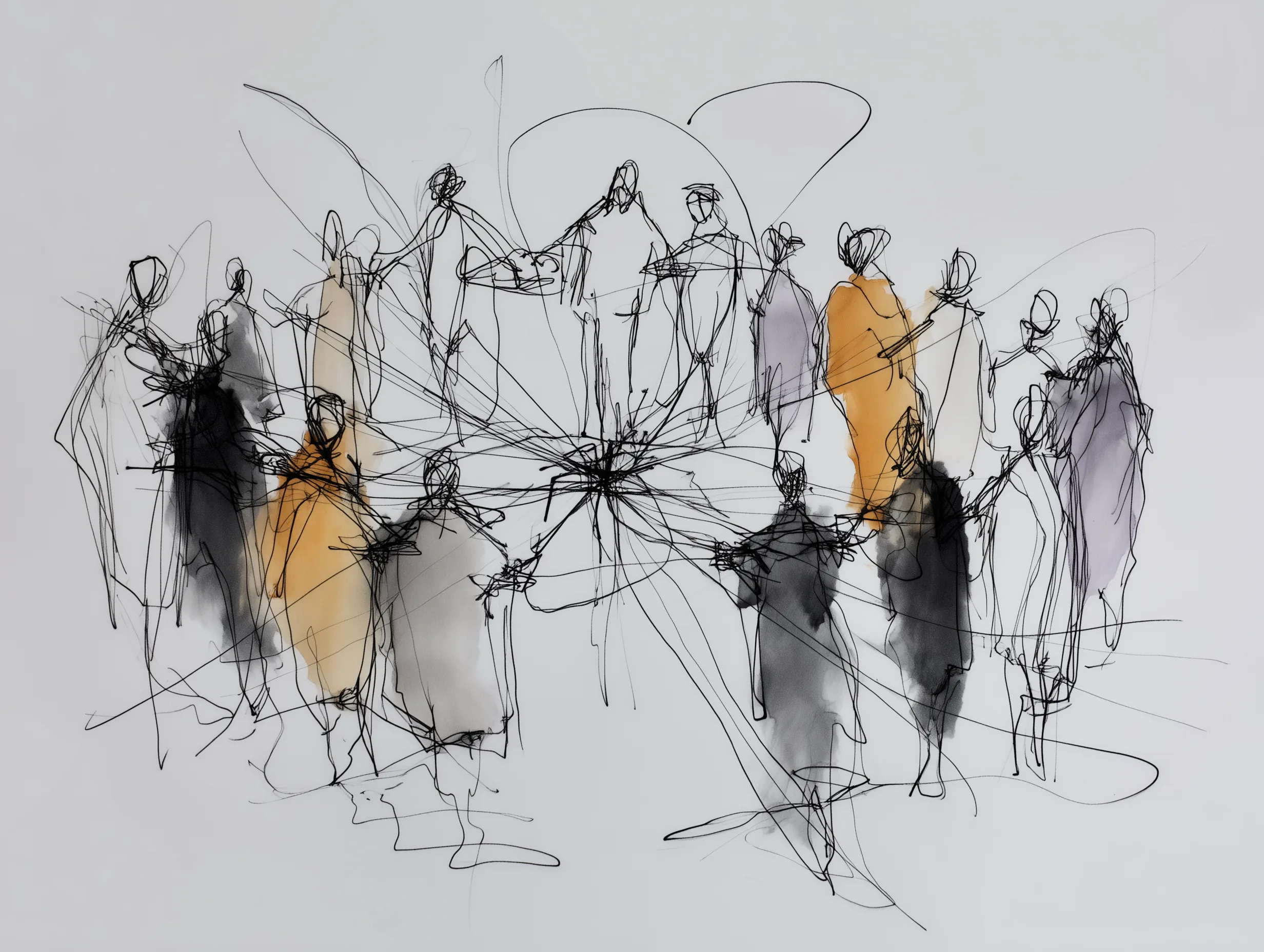
There is a gravitational pull at the heart of the gospel that every generation of Jesus followers is summoned to feel and obey. It is the pull downward and outward — away from the safety of the sanctuary, out of the comfort of the Christendom center, and into the teeming, complicated, beautiful disorder of ordinary human life. This is the incarnational logic of the Jesus movement. To recover it — in its full, disruptive, life-rearranging force — is to recover the very heartbeat of apostolic Christianity.
The transmission of the gospel has always depended on the transmission of people. The medium is the message, and in Christianity that medium is, irreducibly, a human life.
The Primal Pattern
Christianity’s founding logic is incarnational before it is anything else. Before there was a catechism, a creed, or a church building, there was a Person. The eternal Logos, the very ground of all being, did something the Greek philosophical tradition would have considered an obscene impossibility: God moved into the neighborhood. The Word became flesh and pitched his tent among us (John 1:14). This is the irreducible template for everything that follows, the primal pattern to which every generation of Jesus followers is called to return.
What the Incarnation reveals is a God who communicates through total immersion in the human situation. God enters from the inside — taking on flesh, assuming the full weight of the human condition, speaking from within our shared experience of limitation, loss, laughter, and longing. This downward-and-inward movement is the source code of all authentic mission. Every generation of the Jesus community is called to re-enact it in their own cultural moment.
The missional logic flowing from this primal pattern is straightforward in principle and demanding in practice: the gospel must be carried into every cultural context by people willing to embed themselves within it. To send a message, the community of faith must first send people — people willing to become neighbors, to learn the local language of meaning and memory, to translate the eternal story into living, indigenous expression.
Incarnation as Missional Logic
If the Incarnation is the primal pattern, then incarnational mission is the deliberate practice of re-enacting that pattern in every cultural context the gospel seeks to penetrate. It is the logic by which the earliest movement spread with breathtaking speed across the wildly diverse cultures of the ancient Mediterranean world. Paul became “all things to all people” (1 Corinthians 9:22) as a profound theological commitment to the incarnational principle. The message must be translated, given fresh embodiment in every cultural soil it enters.
This translation work — this deeply sacrificial practice of embedding oneself within another culture’s rhythms and re-expressing the gospel from within it — is among the most demanding and most generative tasks to which the Jesus community is called. It requires the willingness to go deep, below the surface of programs and events, into the actual tissue of a community’s daily life. It asks practitioners to arrange their entire lives around genuine presence in a specific human community, allowing the gospel to grow organically from the inside of a culture rather than arriving as an import from the outside.
The incarnational missionary lives with a particular and clarifying question: How do we go to them — and how do we go so deeply that the gospel begins to take indigenous root? Everything flows from the quality of the answer.
The Six Dimensions: A Missional Grammar
To move from principle to practice, it helps to map the incarnational posture across what I would describe as a missional grammar — six interlocking dimensions that together constitute the full embodiment of incarnational life. These are simultaneous, mutually reinforcing orientations of an entire life. Held together, they generate a kind of missional coherence; each dimension drawing out and deepening the others.
Presence. The eternal Creator became fully present in the human situation. Actually, physically, relationally present — inhabiting the same spaces, breathing the same air, sharing the same table. This is the non-negotiable foundation of incarnational practice. Practitioners take this with radical seriousness: they live among the people they are called to serve. They inhabit the same social spaces, walk the same streets, frequent the same gathering places, and allow the unhurried weight of shared time to do what no program can replicate. Presence is a way of life, and it is costly precisely because it demands the gift of the one thing that cannot be manufactured — time genuinely given.
Proximity. Presence opens naturally into proximity — the deliberate, structural arrangement of one’s life so that it continuously intersects with the lives of those one serves. This is what missiologists mean by contextualization, and it goes far deeper than the adjustment of cultural forms. Proximity means inhabiting the actual social geography of a community — its rhythms of work and rest, its gathering places, its networks of kinship and friendship — until one is genuinely woven into the fabric of the culture. Deep love requires deep knowledge, and deep knowledge requires genuine closeness.
Prevenience. This dimension — from the Latin praevenire, to come before — carries a liberating theological recognition: God always arrives ahead of us. There is no cultural territory devoid of divine activity, no human heart in which the Spirit has ceased to work, wooing, preparing, drawing toward the light. The incarnational missionary approaches every community as a discerning co-laborer, joining a redemptive work already in motion. This requires a posture of genuine attentiveness — the willingness to look and listen before speaking, to receive before giving, to honor the sacred traces of God’s prior work already visible in a culture’s longing and beauty and moral intuition.
Powerlessness. The one who held all power in the universe emptied himself, taking the form of a servant (Philippians 2:7). This kenotic movement — this deliberate self-divestiture of positional power, cultural privilege, and institutional leverage — shapes the whole texture of incarnational practice. Mission conducted through mutuality, vulnerability, and servant love carries a persuasive force that institutional authority can never generate. Incarnational practitioners empower rather than manage; they strengthen indigenous leadership and celebrate the community’s own capacity for self-expression and growth. The shape of the mission is always the shape of the cross: downward, outward, self-giving.
Passion. If presence is about location, proximity about relationship, prevenience about theology, and powerlessness about posture, then passion is about the quality of the heart’s engagement with the people one serves. The incarnation was a total empathic immersion — Jesus wept at Lazarus’s tomb, was moved with compassion at the sight of the harassed and helpless crowd, and ached over Jerusalem. Incarnational mission carries this same quality of empathic engagement — a genuine willingness to feel the pain of a community, to be moved by its wounds, to carry its sorrows and share its joys. Communities perceive the difference between professional concern and genuine solidarity. Passion is the quality that makes the difference felt.
Proclamation. The good news is, irreducibly, news — a specific story about specific events with life-altering implications for every human being. It must be spoken, given voice, declared with clarity and joy. And when the messenger has become a neighbor, when a community has experienced the reality of God’s love through years of faithful incarnational presence, the verbal declaration of the gospel story resonates with a depth and credibility that reaches the heart of the culture. The proclaimed word and the embodied life form a single, integrated witness — each amplifying and authenticating the other. Proclamation is the natural culmination of a life fully given to the people one serves.
The Dual Movement: Outward and Inward
What these six dimensions collectively generate is a dual movement that marks all genuinely apostolic communities. The movement runs simultaneously outward — toward the world, into the culture, across the boundaries of comfort and familiarity — and inward — deep into the cultural matrix, below the surface, into the very tissue of a community’s shared life.
When this dual movement is fully operative, something remarkable begins to happen: the gospel produces communities of faith that are genuinely indigenous — organic expressions of the Jesus way that have grown from within the host culture. These communities speak the local language — the deep cultural language of shared memory, local narrative, indigenous aesthetics, and communal identity. Because they have grown from within rather than arrived from without, they carry a cultural credibility and a missiological fruitfulness that multiplies from the inside. The gospel transforms a culture from within, and the evidence of that transformation is communities whose faith expression is entirely their own.
This is the movement the book of Acts describes with such breathless energy: a community propelled outward by the Spirit, going deep into every cultural context it entered, producing disciples and communities of faith that were genuinely, locally alive. The movement spread not through institutional expansion from a single cultural center, but through the multiplication of incarnational communities, each rooted in their own cultural soil, each expressing the same gospel story in their own indigenous voice.
The Urgent Imperative
The Western church stands in a cultural moment that calls for apostolic courage and incarnational imagination in equal measure. The post-Christian West is, in missiological terms, a mission field in every meaningful sense of the phrase — a vast and complex cultural landscape full of people who have never genuinely encountered the Jesus of the gospels, alive with spiritual longing, rich with the traces of God’s prevenient work, and waiting for a community of followers willing to move into the neighborhood and stay.
The incarnational impulse is the primal logic of the gospel itself, written into the DNA of the movement by the One who first enacted it in a stable in Bethlehem and a borrowed tomb outside Jerusalem. It is the logic of a God who insists on moving toward us at whatever cost, and who calls every generation of followers to re-enact that same costly, joyful, self-giving movement in their own time and place.
The Incarnation is the means of our salvation and the pattern of our mission. To recover this pattern — in its full disruptive, neighborhood-entering, culture-embedding force — is to recover the most ancient and most generative impulse in the Christian tradition. The movement waits for people willing to live it