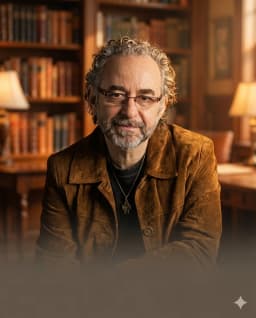



Most of us have been reading Ephesians 4 with the wrong people in the room.
The mental image is almost universal: a leadership team, a training seminar, a conference table of credentialed ministers sorting out who holds which office. That image is so deeply grooved by centuries of institutional habit that it shapes the question we bring to the text before we have read a single word of it. The question becomes: Which leaders get which role? And the moment we ask it that way, we have already missed what Paul is actually doing.
The assumption buried inside that question is the one that needs examining. It assumes the fivefold — the apostolic, prophetic, evangelistic, shepherding, and teaching intelligences given by the ascended Christ — is a management structure for a professional class. It assumes that when Paul wrote "to each one of us grace has been given as Christ apportioned it," he was writing to a committee. He was writing to a room full of artisans, laborers, women, and slaves.
That difference is everything.
The Room Paul Was Writing To
Strip away the wood-paneled boardroom. Strip away the seminary. Strip away every image of professional ministry that has accumulated over sixteen centuries of Christendom, and ask the simpler question: Who actually received this letter?
When Paul's letter arrived in Ephesus, it was read aloud — in a home, most likely, to the whole gathered community. That community was gritty and diverse and largely marginalized. Artisans. Laborers. Merchants. Women. And — most scandalously for the Greco-Roman world — slaves. People the empire considered sub-persons. People who, by every social calculus of the day, had no standing to wield anything resembling institutional authority.
To this group, Paul announces something that should still stop us cold.
The Victorious Christ — the one who descended into the lowest parts of the earth and then ascended to fill all things — has given his own ministry to these people. The word that carries the weight of the claim is hekasto: to each and every one. It is precise and it is total. The disempowered become the primary agents of a cosmic revolution. That is not a minor footnote in the theology of ministry. It is the entire logic of the movement Jesus started.
There is a kind of arithmetic at work here that the ancient world found frankly incomprehensible. The empire distributed power upward, toward those who had already demonstrated their capacity to hold it. Jesus distributes his own ministry outward and downward, into the hands of people the empire had written off entirely. The genius of the movement is located precisely there — in the universality of the distribution.
The Ascension as Mass Distribution
The genesis of APEST lies in the ascension, and it is worth sitting with that before moving anywhere else.
In his ascension, Jesus — having recapitulated and redeemed all things — does not hoard his ministry. He distributes it. He parses out his own apostolic, prophetic, evangelistic, shepherding, and teaching capacities and embeds them into the fabric of his Body. This is what I mean in 5Q when I describe APEST as the Body's "distributed intelligence" — the élan vital, the active force of life resident in the whole organism. Think of it as the routinization of the charism of the founder: Jesus ensures that his own ministry is not locked in a single person or a single office but woven into the DNA of every member.
Max Weber, the sociologist, observed that every movement faces a particular crisis when its founder departs. The vision, the energy, the irreplaceable charisma of the originating figure — what happens to all of that? The movements that survive are the ones that find a way to distribute the founding charism into the life of the whole community, into its rhythms and structures and culture, so that the movement can carry on without depending on any single personality. Weber called this "the routinization of charisma."
What Paul describes in Ephesians 4 is the ultimate version of this. In the ascension, Jesus routinizes his own fivefold ministry into the very genesis and genetics of his church. He does not leave behind a set of instructions to be managed by a committee. He leaves behind himself — parsed out, distributed, alive in every member of the Body.
This is why the early church grew the way it did. By AD 100, there were perhaps 25,000 Christians across the Roman Empire. By AD 310, that number had reached somewhere near 20 million. No buildings. No professional clergy. No centralized hierarchy. No political favor — in fact, the empire was actively trying to destroy them. What they had was the full ministry of Jesus, distributed and decentralized, carried by ordinary disciples who understood themselves to be each called, each gifted, each sent.
The Chinese underground church traced the same arc. In 1949, when Western missionaries were expelled, there were roughly 2 million Christians in China. By the year 2000, that number had grown to an estimated 120 million. The mechanism was identical: a fully functioning fivefold ministry, distributed throughout the body, carried by people the world would consider wholly unqualified. The design functioning exactly as intended.
What we see in both movements is the unleashing of the full ministry of Jesus through the full APEST system. And it is reproducible — because the DNA is already there.
Five Dimensions of One Christ
These five capacities are not five different jobs. They are five dimensions of a single reality: the personality of Jesus himself, distributed into the whole people of God.
Jesus is the perfect Apostle — the one sent from the Father, extending the mission to the ends of the earth. He is the perfect Prophet — speaking the word of the Lord with absolute fidelity, calling his people back to covenant faithfulness. He is the perfect Evangelist — the one whose very presence is good news, who seeks and saves the lost. He is the perfect Shepherd — who lays down his life for the sheep, who knows each one by name. He is the perfect Teacher — who opens the scriptures, who makes the blind see, who transforms the mind. His life is saturated with all five. And in his ascension, he gives what he is to those who belong to him.
This is why the goal Paul articulates is Christological, not merely functional. The destination is "the whole measure of the fullness of Christ" — a community that, together, embodies what only Jesus perfectly embodies alone. Some in the community will carry a concentrated apostolic calling. Some will carry a concentrated prophetic one. The whole community is to be apostolic. The whole community is to be evangelistic. The leadership tier carries these callings in a representative and exemplary way; the entire body lives them out in every direction.
Think of it as the difference between a tuning fork and an orchestra. The tuning fork does not play the music. It strikes a note so the whole orchestra can find the pitch. That is what concentrated APEST leadership does — it resonates, and the whole body resonates in response. The music belongs to everyone. The tuning fork serves everyone.
This is the distinction that matters most and is most commonly missed. APEST is a ministry culture — an environment in which every disciple understands their calling within the fivefold framework, in which every person is equipped and released for the work of ministry, and in which the whole body moves together toward the fullness of Christ.
Leadership as Implication, Ministry as Calling
A striking feature of Ephesians 4 is the total absence of the word "leadership." Paul is writing a ministry text, addressed to the whole assembled ecclesia. The word "office" appears nowhere in the original language; it is a later institutional overlay that has done considerable damage to our reading of the passage.
Leadership is present in the text, but as an implication of the equipping function, not as the text's primary subject. The Greek word katartizō — usually translated "equip" — carries a remarkable range of meanings: to mend what has been broken, to perfectly join together, to restore someone to what they ought to be. The task of those who carry concentrated APEST callings is to activate those same capacities in the whole body. The apostle equips the community to function apostolically. The prophet equips the community to function prophetically. Leadership, in this frame, is the specialized service of helping everyone else find and inhabit their place in the fivefold symphony.
Not everyone is called to be a leader. Every single person is called to be a minister. That distinction carries no demotion. It is a profound elevation — in fact, let me say it plainly: it is a remarkable elevation — of what it means to belong to the Body of Christ. Every artisan in that Ephesian home was a minister of the gospel. Every slave. Every woman. The whole room was the whole ministry.
The Scenius of the Body
There is a concept I have found remarkably useful here, borrowed from the musician Brian Eno: scenius — the collective intelligence of a whole community or creative scene. Eno coined the term to push back against the myth of the lone genius, the idea that world-changing art or thought is produced by isolated individuals of exceptional talent. What actually generates extraordinary work, he observed, is fertile scenes — ecologies of talent, curiosity, and mutual provocation — that give rise to things no individual could have produced alone.
The Body of Christ, when functioning according to its design, is precisely this. It is pure scenius.
The 5Q of the body — its fivefold quotient, the measure of Christ's active presence in the community — rises as each member inhabits their particular calling and contributes their particular intelligence to the whole. The apostolic vision stretches the horizon. The prophetic voice holds the community to its covenant. The evangelistic energy keeps the movement porous and outward-facing. The shepherding presence creates the safety in which people can risk and grow. The teaching wisdom roots the community in truth deep enough to sustain the journey.
C.S. Lewis once observed that friendship arises at the moment when one person says to another, "What, you too? I thought I was the only one." The scenius of the Body works something like that — the recognition that the gift you carry is not a private possession but a contribution to a shared intelligence. The apostle discovers the prophet. The shepherd discovers the teacher. And in that mutual discovery, something emerges that is larger than any of them.
We do not need to import these capacities from outside. They are already present — latent in the body, waiting to be activated. The seed of the movement is already in the ground. The question is whether we will cultivate the conditions for it to germinate.
What Becomes Possible
The early church did not grow because it had the right programs or the right professionals. It grew because it had the right DNA — and every member of the body was carrying it, living it, passing it on.
That DNA has not changed. The ascended Christ has not rescinded the gift. The hekasto of Ephesians 4 still stands: to each and every one, grace has been given as Christ apportioned it. The question before us is not whether we have what it takes to become a movement. The question is whether we are willing to trust that Jesus has already given us what we need — and to release it, in every member, into every corner of the world he came to fill.
This is how the whole universe gets filled with the fullness of Christ: through a people where everyone is empowered, everyone is gifted, and everyone is sent.
The room in Ephesus was full of people the empire had dismissed. It turned out to be the most dangerous room in the ancient world.